
The integration of Artificial Intelligence (AI) into the workplace is no longer a distant theoretical concept; it is an active, structural realignment happening right now. Across the globe, and particularly in tech-driven economic hubs like Southeast Asia’s IT and Business Process Management (IT-BPM) sectors, AI is fundamentally altering how we work. However, experts within the sources note that this technological shift is less about outright job replacement and far more about job redefinition.
To remain competitive, the workforce of tomorrow must embrace a new paradigm of “hybrid intelligence,” where humans and AI collaborate as equal partners. The future belongs not to those who compete with machines, but to those who learn to wield them effectively.
The New Technical Baseline: Digital Fluency and AI Expertise As routine and repetitive tasks—such as data entry, basic coding, and standard customer inquiries—are increasingly automated, the demand for specialized technical skills is surging. There is a critical need for professionals adept in data science, machine learning, AI engineering, and cybersecurity.
Furthermore, completely new roles are emerging to support and manage AI systems. Positions like AI fine-tuners, data annotators, and AI governance leads (who oversee ethics, bias, and compliance) are becoming vital. However, you do not need to be a software engineer to survive. Basic AI literacy is becoming mandatory across all professions; workers must learn how to manipulate AI applications, craft effective prompts, and integrate these tools into their daily workflows to boost productivity.
The Uniquely Human Advantage: Empathy and Complex Problem Solving: While AI excels at processing massive datasets and executing standard operational loops, it remains fundamentally “context-blind”. It lacks intrinsic imagination, ethical reasoning, and the ability to build genuine rapport. Consequently, jobs that rely heavily on human connection, complex decision-making, and emotional intelligence are highly resistant to automation.
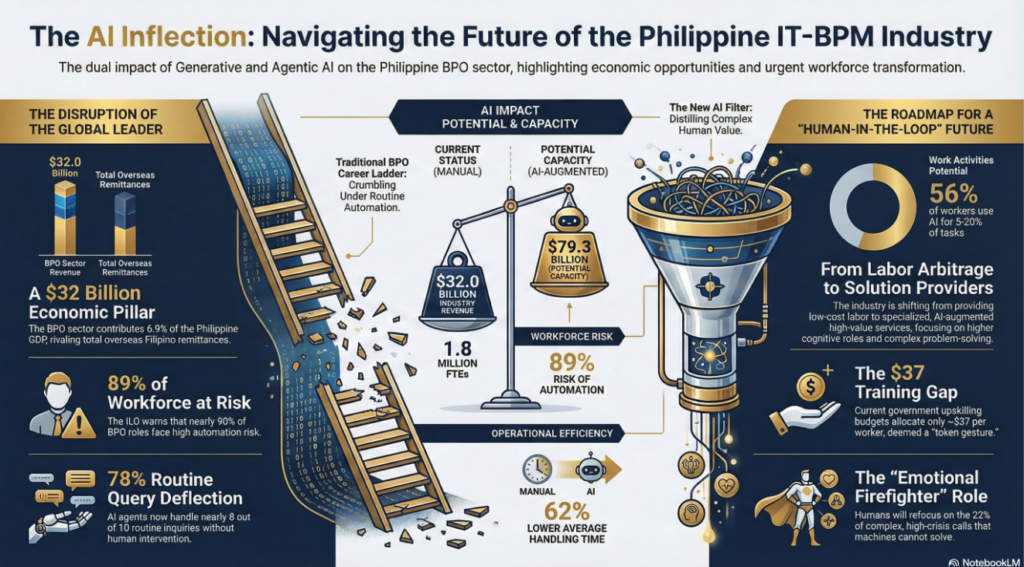
In customer-facing roles, for example, simple queries are now deflected to AI chatbots, leaving human agents to handle only the most complex, emotionally charged, and high-stakes “exceptions”. This means the cognitive and emotional load on human workers will increase, making skills like empathy, negotiation, persuasion, and critical thinking more valuable than ever. Similarly, roles in healthcare, creative arts, leadership, and specialized strategic consulting will continue to lean heavily on the uniquely human ability to navigate unpredictable environments and establish trust.
Adaptability and the Continuous Learning Mindset: The pace of technological change means that static skill sets will quickly become obsolete. A recent survey highlights that while fear of AI replacement is valid, workers who successfully adapt share key qualities: adaptability, curiosity, and a relentless commitment to continuous learning.
The future of work will reward cross-functional fluency—the ability to blend AI literacy with deep, specialized domain expertise. Governments and organizations are increasingly recognizing that overcoming the current “skills mismatch” requires massive investments in upskilling and reskilling programs.
Ultimately, the AI era is not about humans being replaced, but about humans being reimagined. By cultivating a strong foundation in both emerging digital tools and irreplaceable human empathy, today’s professionals can secure their place in the workforce of tomorrow.
